

Rockstud versus Rockstud Spike: Which One Suits You
Two lines on the same shelf share the same pyramid stud, and deciding between them costs somewhere between one thousand and two thousand dollars. That is the honest framing of the Rockstud and Rockstud Spike question, and that explains why so many buyers stall out halfway through the decision. Their likeness is genuine, and yet they behave differently in the hand, in the wardrobe and on the resale market. One handles the everyday and the other evenings, and the price gap between them is not decorative. What follows puts them side by side on what actually drives the outcome: what each costs at observed 2026 market prices, what materials each uses, what formats exist, and which survives contact with an ordinary week. What follows is built from what is currently live: both lines remain in the brand’s own bag filters in September 2026.
Same motif, different tiers
What unites them is the place to start, since it is why the comparison exists. Both are centred on the flat pyramid stud that has become the most recognisable hardware in the house’s leather goods, and both are current rather than archival. Where they split is tier. The entry and lower-middle band belongs to Rockstud at $1,250 to $2,100 at observed 2026 market prices, with Rockstud Spike a full valentino step above at $2,400 to $3,700. What the gap measures is a shift in materials, in size and in how dressed-up each line is asked to be, not a difference in studs. Rockstud is the motif in daylight, Rockstud Spike the motif in the evening; most other differences follow from that.
How the studs arrived
The pyramid stud arrived in Fall 2010, introduced by Maria Grazia Chiuri and Pierpaolo Piccioli during their period as co-creative directors of the house. Since it began on footwear rather than handbags, the motif’s proportions make sense: the studs were designed to catch light on a curved surface before moving onto flat leather panels. The reference cited in the design is bugnato rustication, meaning the rough-cut stonework on Renaissance palazzo façades in Rome, apt for a house whose creative headquarters is Roman. One piece of chronology often gets muddled online: the motif appeared three years after Valentino Garavani retired from design in 2007, so the studs were never his work, and he died in January 2026 having had no ownership of the company since 1998. Any confident date for the Rockstud bag launch deserves suspicion: the year is repeated widely but rests on a single source. Both stud lines survived the transition intact when Alessandro Michele took over creative direction, which he has led since 2024.
Rockstud in 2026: the line that works for a living
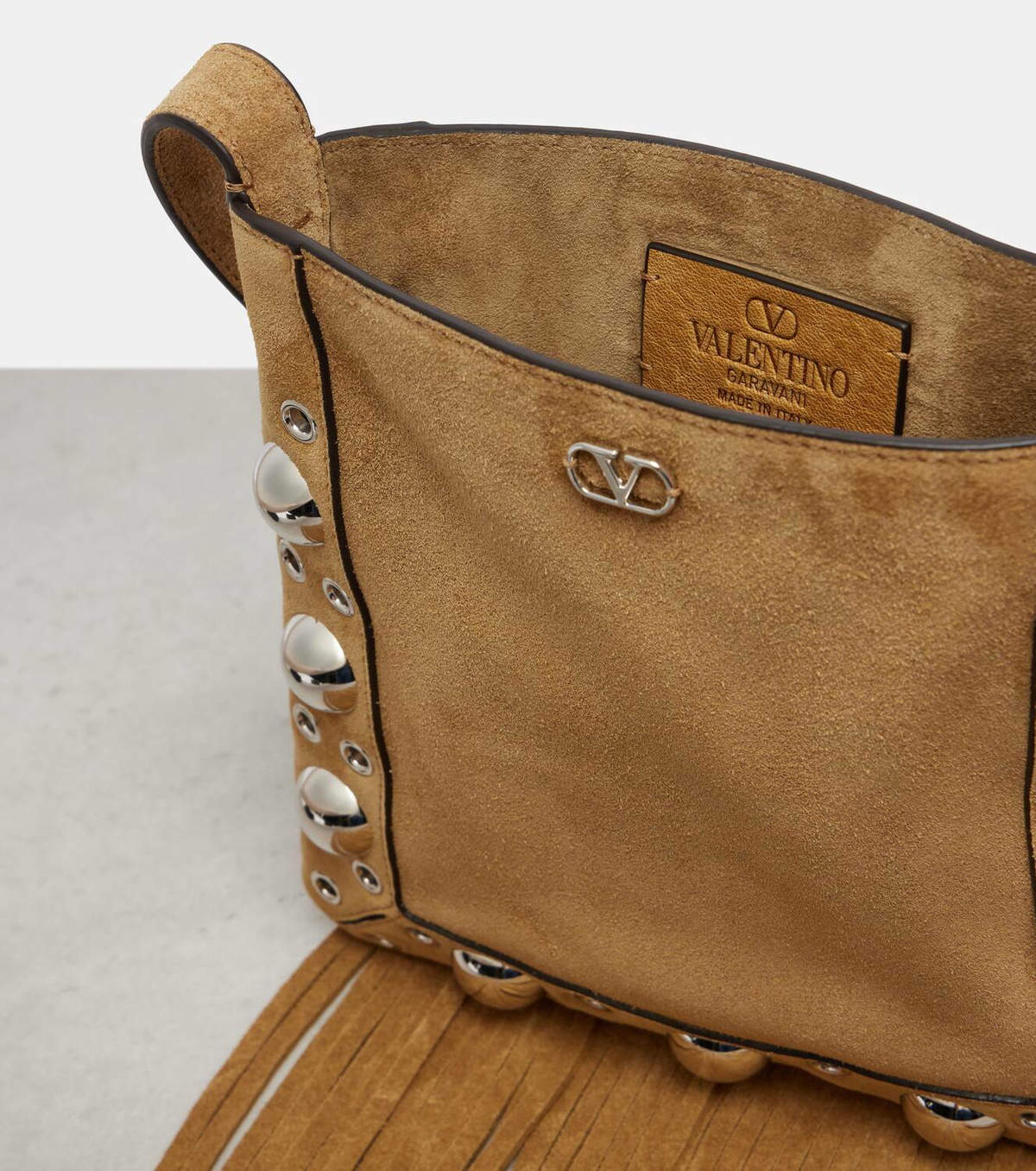
Rockstud is the wider and more practical of the two, with roughly fifty-two pieces observed live on the brand’s own site. Hard-wearing is the direction of the material palette; grainy calfskin anchors it, and suede, raffia, laminated calfskin and pony-effect calfskin fill out the seasonal edges. The everyday formats are the real argument for this line. A mini shopping tote costs $1,390 in grainy calfskin or suede and $1,490 in raffia, rising to $1,750 laminated and $1,850 in pony-effect. A small valentino crossbody bag in grainy calfskin runs between $1,650 and $1,950, the laminated version at $1,790, while a small valentino shoulder bag hits $1,950 in suede and $2,100 in grainy calfskin. The floor is a laminated calfskin wallet at $1,250, making it the cheapest way into the motif outside the clutches.
Rockstud Spike in 2026: the dressed-up sibling
Narrower, softer and pricier, Rockstud Spike is built for a different part of the week. Away from the grainy calfskin of the base line, the observed palette favours nappa, suede, kidskin and embroidered nappa, all more supple and less forgiving of scuffs. What dictates the pricing is materials rather than studs. The line opens with a crossbody clutch at $2,400, then a small suede at $2,550 and a small nappa at $2,800; medium sizes run from $2,750 to $3,200 in suede, $2,950 in kidskin and $3,500 in nappa, and a medium embroidered nappa tops out at $3,700. That last figure is revealing, because embroidery is where the line starts behaving like the top of the range rather than its commercial core. Choice is thinner here than on the base line, so the piece you want may simply not exist in the material you want.
Head to head: the numbers
Weigh the two lines directly and the pattern that emerges is clean rather than subtle. The Rockstud range fits entirely beneath the starting price of Rockstud Spike, with a $300 gap between the top of one and the bottom of the other. Materials tell the same story from a different angle, because one palette is chosen for wear and the other for drape. Formats matter too: the base line gives you a tote and a wallet, which the Spike does not, while the Spike adds a crossbody clutch that reads as evening. The figures below are observed 2026 market prices from the brand’s own United States site rather than an official price list, and they shift with material and season. Where the two lines overlap is barely anywhere, and the table makes that plain.
| Basis of comparison | Rockstud | Rockstud Spike |
|---|---|---|
| Observed 2026 range, US | $1,250 to $2,100 | $2,400 to $3,700 |
| Lowest observed piece | Laminated calfskin wallet, $1,250 | Crossbody clutch, $2,400 |
| Highest observed piece | Small shoulder in grainy calfskin, $2,100 | Medium embroidered nappa, $3,700 |
| Observed materials | Grainy calfskin, suede, laminated calfskin, pony-effect, raffia | Suede, kidskin, nappa, embroidered nappa |
| Formats in the line | Wallet, mini shopping tote, small crossbody, small shoulder | Small shoulder, medium shoulder, crossbody clutch |
| How much choice | Around fifty-two pieces live | Noticeably narrower |
Which suits your week
Taste settles this far less often than frequency of use does. Where the bag goes to work, holds a phone and a wallet and survives rain twice a month, the sensible answer is the grainy calfskin Rockstud, and the mini shopping tote is its most useful shape. Dinners, events and evenings where you carry almost nothing favour the Spike, whose nappa and suede deliver a softer body and a richer surface; there the crossbody clutch is the format that earns its keep. Across the two, colour reads differently as well, given that suede and nappa hold saturated tones in a way grainy calfskin does not. There’s also a navigation quirk worth knowing, in that the brand’s own United States site has no crossbody category page, listing bags instead under shoulder bags, totes, top handle bags, clutches, wallets and small leather goods. Searching for a valentino crossbody bag on the house’s own site therefore works better as a filter by size than as a category, even though most major retailers do maintain crossbody pages.
How each fares on resale
As an asset, neither line makes sense, and the numbers make that plain rather than encouraging. One major resale platform recorded Valentino handbags across the house at roughly 41 per cent of retail in 2023: mid-tier, and well below the strongest names. For anyone weighing these two, the useful part is that the motif bags outperform that average. Observed retention on that platform includes a Rockstud drawstring bucket at about 56 per cent, a Rockstud flip lock flap at about 56 per cent and a Rockstud pouch crossbody at about 50 per cent. The Spike offers a lone illustrative figure rather than a dataset: a medium example observed at roughly $1,700 second-hand against roughly $2,900 new, near 59 per cent but resting on one listing and not to be generalised. Recognisability holds value here, which is the practical reading; both lines resell better than the quieter valentino bags, and the base line costs less to be wrong about.
The short version
Rockstud is the one to buy if this is your first valentino garavani bag or your only one. Lower in price, wider in choice, built from materials that tolerate daily handling, and it includes the two formats most people reach for: a tote and a wallet. Rockstud Spike is the answer if you already own something from the house, want the motif in a softer material, and will use the bag in the evening rather than on a commute. The material difference is the whole point of the price gap, so do not buy the Spike expecting the base line’s durability, or the base line expecting the Spike’s drape. On the fence, with a budget that reaches either way? Put the difference on a better colour and material within the base line rather than on the tier above. Do that and you tend to end up with a bag people wear more, which is the only performance metric that survives contact with a wardrobe.
Leave A Comment